Picture yourself walking through Police Bazar in Shillong on a weekday afternoon. Shopkeepers glance at their watches, a small crowd gathers near a tea stall, and someone announces a two digit number that makes half the street either smile or shrug. You ask what just happened, and a local grins: “Teer result.” If that scene leaves you asking what is shillong teer, this guide is written for you. It is a complete beginner’s walkthrough of the archery lottery that shapes daily life in Meghalaya’s capital: how the game is played, how the numbers are born, why the law allows it, where the tradition comes from, and how you can experience it yourself, whether as a curious reader, a respectful spectator, or a first time participant who wants to do everything by the book.
What Is Shillong Teer – A Newcomer’s Guide
Shillong Teer is a lottery unlike any other in India, because its winning numbers are not drawn from a machine. They are shot out of bows. On every working day, licensed archery grounds in Shillong host two rounds of competitive shooting. In each round, dozens of archers fire arrows at a target for a fixed number of minutes. When time runs out, officials count the arrows that hit the target. The last two digits of that count become the result, a number between 00 and 99. Before each round, players buy low cost tickets at licensed counters, picking the number they think the arrows will produce. Match the declared number and you win a prize.
That is the game in a paragraph. But anyone who stops there misses what makes teer fascinating. The archers are real athletes carrying a centuries old Khasi tradition. The grounds are supervised by licensed associations under Meghalaya state law. The counters that sell tickets are authorised businesses that pay tax. And the few minutes of shooting each afternoon are a communal event that offices, markets, and neighbourhoods across Shillong organise their day around. When beginners ask what is shillong teer, the honest answer has four layers: a sport, a lottery, a licensed industry, and a cultural institution. This article walks through all four, step by step.
A Brief Shillong Teer History
Archery Before the Lottery
Long before there were tickets or result websites, there was the bow. The Khasi hills were historically a land where the bow and arrow were essential tools. Hunters depended on them, villages defended themselves with them, and young men proved themselves through them. Archery contests between villages were major social occasions, part sport and part ceremony, and the skills were passed from father to son along with the discipline and patience the bow demands. This heritage is the deep root of everything that follows. Teer did not invent archery in the Khasi hills. It inherited it.
The Colonial Era and the Growth of Wagering
During the British colonial period, Shillong became an important administrative town, the summer capital of Assam province and later the capital of Meghalaya. As the town grew, so did its archery gatherings. Spectators began placing informal wagers on the outcomes of shooting contests, a natural extension of a competitive tradition. By the mid twentieth century, these contests with their informal betting had become a fixture of Shillong life. They were open secrets: everyone knew about them, the authorities tolerated them, and the crowds kept growing.
From Grey Zone to Licensed Lottery
The decisive chapter in shillong teer history came when the government of Meghalaya decided to regulate rather than prohibit the game. Under India’s Constitution, lotteries fall under state jurisdiction, and Meghalaya used that power to create a licensing framework for teer. Archery associations were authorised to organise the game, ticket counters were licensed, the shooting was brought under official supervision, and the state began collecting tax on the turnover. The informal contest became a formal institution. That decision, taken decades ago, is why teer today is conducted openly at recognised grounds with published timings and declared results, instead of in the shadows. Readers interested in the wider context can look at the history of Shillong and the sport of archery to see how the city and the sport each shaped the game.
How Teer Works, Step by Step
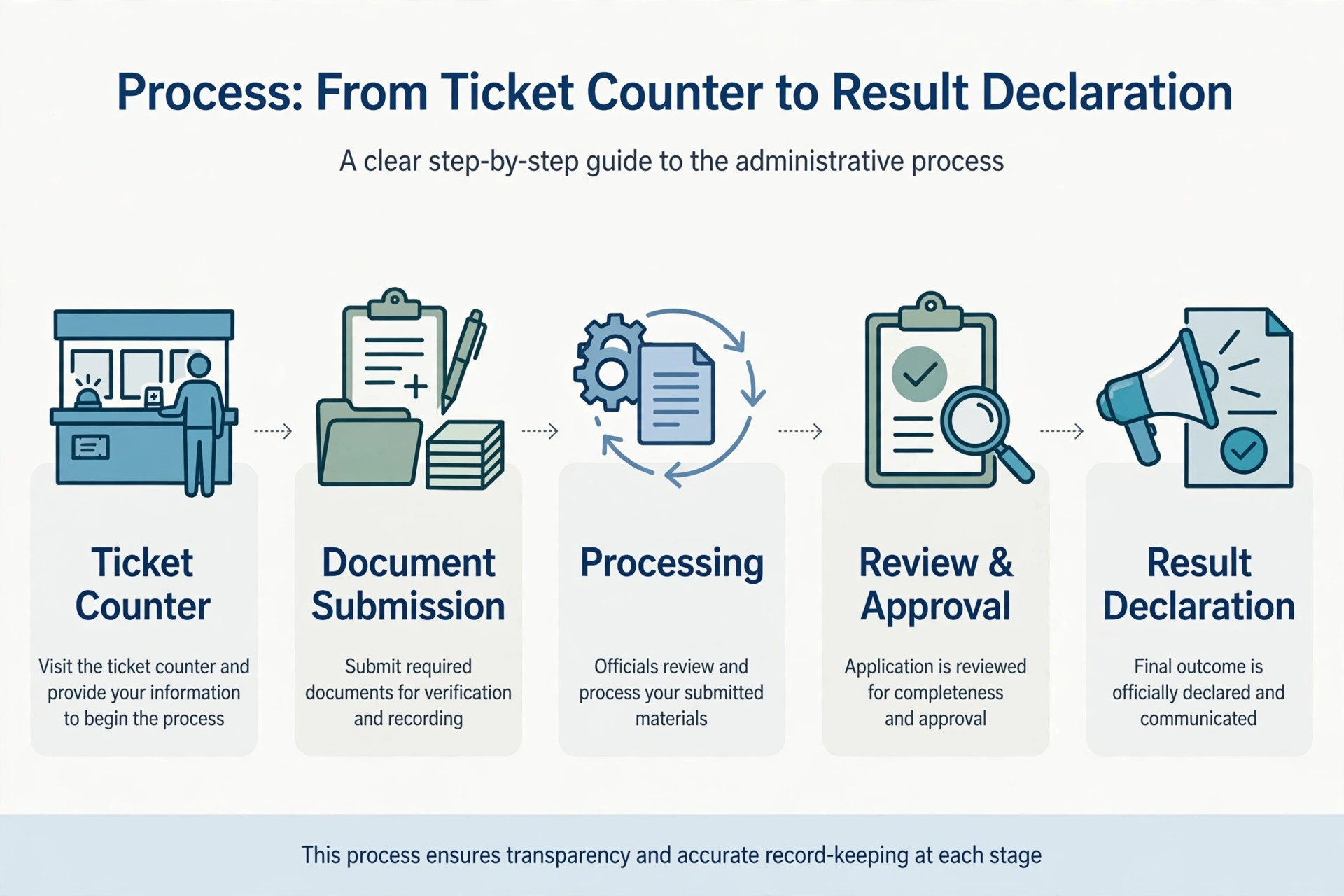
Step 1 – Tickets go on sale at licensed counters
The day begins at the counters. Licensed agents across Shillong sell tickets for the day’s rounds. Each ticket carries the number the player has chosen, any number from 00 to 99, along with the round it applies to. Prices are kept low by design, so that participation stays accessible to ordinary people. Sales for a round close shortly before the shooting begins.
Step 2 – The archers take their positions
At the licensed ground, the archers assemble. These are not casual hobbyists. They are trained shooters, many of whom earn their living from the game, using traditional style bamboo bows. Officials verify that the ground, the target, and the timing equipment are in order, and the crowd settles.
Step 3 – The shooting round begins
On the signal, the archers begin shooting. Each archer fires arrow after arrow at the target, working against the clock. The round typically lasts a few minutes, and the ground falls into a focused quiet broken only by the sound of the bows. This is the sporting heart of the teer game, and it is genuinely thrilling to watch.
Step 4 – Officials count the arrows
When time expires, shooting stops immediately. Officials then count every arrow that has struck the target. The count is done openly, in view of the archers and the spectators, because transparency is the foundation of trust in the game.
Step 5 – The result is declared
The last two digits of the arrow count become the winning number for the round. If the count ends in two digits, those digits are announced as the result. The First Round (FR) result is declared in the afternoon, and the whole cycle repeats about an hour later for the Second Round (SR), giving each day two independent results.
Reading the Result – FR, SR, and the Two Digit Format
Newcomers are often confused the first time they see a teer result, so here is how to read one. A standard daily listing shows the date, then two entries: FR and SR. Each entry is a two digit number from 00 to 99. The FR number comes from the afternoon shooting round and the SR number from the later round. They are completely independent. A ticket bought for the FR round can only win against the FR number, and the same applies to SR.
The two digit format has a simple logic. Because only the last two digits of the arrow count are used, the result always falls between 00 and 99, which keeps the game easy to play: one hundred possible outcomes, one ticket per chosen number. When you see a result published as a placeholder like “-” before declaration, that simply means the round has not been shot or counted yet. After declaration, reputable sites update quickly. You can follow the Shillong Teer result page here for the day’s declared numbers, and the teer result list archive keeps past days for reference. Declared timings are fixed by the organising associations, though small delays can happen on days with heavy rain or special circumstances, so give the updates a few minutes.
Why the Teer Lottery Is Legal in Meghalaya
Lotteries Are a State Subject
The single most important legal fact about teer is that the Indian Constitution leaves lottery regulation to the states. Some states run their own lotteries, some allow private ones under license, and some ban lotteries altogether. Meghalaya belongs to the first group in spirit: it permits lotteries and chose to regulate teer within that permission. That is why the question “is teer legal” has a geographic answer. In Meghalaya, under Meghalaya law, it is a licensed lottery. The legality travels with the state’s jurisdiction, not with the internet.
The Licensing System in Practice
The Meghalaya framework works through licenses at every level. The archery associations that organise the shooting hold authorisation from the state. The grounds where the rounds take place are recognised venues. The counters that sell tickets are licensed agents operating under the associations’ supervision. Money flows through this chain in an accounted way, and the state collects its tax and fees. This is what separates the legal teer lottery from underground betting: paperwork, supervision, accountability, and a share for the public purse.
Supervision You Can See
Legality is visible at the grounds. Officials oversee the shooting, the timing, and the counting. Results are declared publicly rather than announced from an office. Winning tickets are honoured at the counters because the agents operate inside a system where they are answerable. For a player, this means the game is as transparent as a lottery can be. You can literally watch your number being decided.
The Boundaries of the Law
Understanding the meghalaya teer legal framework also means understanding its edges. The licensed game is physical: counters and grounds inside Meghalaya. Online ticket sales are not part of the licensed system, and websites or apps offering to sell you teer tickets over the internet are operating outside it. Participation is restricted to adults aged 18 and above. And because other states set their own lottery rules, the game cannot simply be exported elsewhere. These boundaries protect the integrity of the system, and respecting them is part of playing responsibly.

Culture at the Grounds – Teer and Khasi Community Life
To spend an afternoon at a teer ground is to understand why the game matters beyond money. The archers arrive with the quiet focus of craftsmen. Older men who have shot for decades stand alongside younger archers learning the trade. Spectators include shopkeepers on a break, retirees who have watched for years, and curious visitors. The atmosphere is communal rather than frenzied. People discuss the archers’ form the way football fans discuss players, with opinions, loyalties, and long memories.
For the Khasi community, teer carries a cultural weight that outsiders sometimes miss. Archery was historically a marker of Khasi identity, tied to hunting, defence, and village honour. The modern game, for all its lottery machinery, keeps that thread alive. The bamboo bows, the traditional shooting style, and the communal watching connect today’s Shillong to the village contests of centuries past. Festivals and family gatherings still feature archery as a cultural display, and the daily lottery is its professionalised cousin. When elders speak of teer with pride rather than embarrassment, this is why: the game preserved a heritage skill by giving it a modern livelihood.
The daily rhythm matters too. Teer gives the city a shared pause, a few minutes when strangers share the same anticipation. In a fast changing Shillong, where new buildings and new businesses reshape neighbourhoods every year, that continuity has real social value.

The Local Economy of Meghalaya Teer
Behind the cultural story sits a hard economic one. Teer is a significant local industry, and its money reaches deep into ordinary households.
The most visible workers are the archers themselves, who train, compete, and earn from the licensed events. Around them stands a larger workforce: licensed counter agents and their assistants, ground staff, timing and counting officials, transporters who move equipment, and the administrators of the organising associations. Each counter is a small business paying rent, wages, and tax. Multiply that across Shillong and the neighbouring teer centres, and the direct employment runs into the hundreds of families.
Then there is the state’s share. Tax and license fees from the teer lottery flow into Meghalaya’s public finances, funding the same roads, schools, and hospitals that every other revenue stream supports. This fiscal contribution is one of the strongest arguments the game’s defenders make: regulation turned an untaxed informal economy into a contributor to the public purse.
The indirect effects spread wider still. Tea stalls and food vendors cluster around busy grounds and counters. Transport operators ferry archers and spectators. Printers produce tickets and signage. None of these livelihoods would exist in the same form without the daily cycle of the game. For a hill state with limited large scale industry, that kind of distributed, labour intensive employment is genuinely valuable, and it explains why teer policy is treated in Shillong with the seriousness of any major economic question.
Myths vs Facts Every Newcomer Should Know
Myth – Someone controls the result behind the scenes
Fact: the number comes from arrows shot in public and counted in the open. Dozens of independent archers would all have to cooperate to fix a count under the eyes of officials and spectators. The licensing system and the public count make manipulation impractical, which is exactly why the format has survived.
Myth – Skilled players can calculate the winning number
Fact: skill is what makes the result unpredictable. Even champion archers have off days, and wind, light, and nerves move the count by arrows nobody can foresee. There is no formula, no pattern, and no insider method. Anyone selling you a guaranteed number is running a scam.
Myth – Teer is just gambling with a traditional costume
Fact: teer is a state licensed lottery with regulated organisers, supervised events, and tax paid to the government. The archery is not decoration. It is the actual mechanism of the draw, and the tradition behind it predates the lottery by centuries.
Myth – Online sites can sell you official teer tickets
Fact: the licensed game operates through physical counters in Meghalaya. No website or mobile app is authorised to sell official teer tickets online. Result websites, including this one, publish the declared numbers for information. They do not sell tickets, and any site claiming to do so should be treated with suspicion.
Myth – You need to understand complex rules to take part
Fact: the rules fit in a sentence. Pick a number from 00 to 99, buy a ticket for the round you want at a licensed counter before sales close, and check whether it matches the declared result. Everything else, the history, the culture, the timings, is context that enrichs the experience but is not required to participate.

A Tourist’s Field Guide to Experiencing Teer
If you are visiting Shillong, teer is one of the most distinctive local experiences available to you, and it costs nothing to watch.
Finding the Grounds
Licensed teer grounds operate in and around Shillong on working days. Your hotel or a local taxi driver can point you to the nearest one. Aim to arrive before the afternoon round begins so you can watch the archers prepare, which is half the pleasure.
Ground Etiquette
Treat the ground like the workplace it is. Stay behind the spectator areas, keep conversation low while shooting is in progress, and never walk onto the field or distract an archer. Photography is generally acceptable from a distance, but ask permission before photographing individuals up close. The archers are professionals at work, not performers, and the regulars around you are neighbours following a daily ritual.
If You Want to Buy a Ticket
Adults aged 18 or above may buy tickets at any licensed counter. Look for the official signage, choose your number, and keep your ticket safe. Set a small budget in advance and treat the purchase as entertainment spending. If you are unsure about anything, watch a round first and ask a counter agent to explain the process. They deal with first timers regularly and will walk you through it.
What to Take Away
The best souvenir from a teer ground is not a winning ticket. It is the memory of fifty bows drawn in unison, the hush before the count, and the ripple through the crowd when the number is announced. That is the living culture behind the digits you see on result pages.
Playing Responsibly
Teer is a legal lottery in Meghalaya, for adults aged 18 and above only, and it should be approached with the same caution as any form of paid gaming. A ticket is entertainment spending, not an investment, and the expected outcome of any single ticket is a loss. Decide your budget before you play, never exceed it, and never borrow money to buy tickets. Do not chase losses: buying more tickets after a losing round does not improve your position, it only deepens the hole. If playing stops being fun, or if you notice yourself hiding your spending or playing with money meant for essentials, stop immediately and talk to someone you trust. Support services for problem gaming exist, and reaching out is a sign of sense, not weakness. Learn more about our approach on the about us page, and if you need to reach us, the contact us page is available.
Frequently Asked Questions About What Is Shillong Teer
What is Shillong Teer exactly?
Shillong Teer is a legal archery based lottery organised daily in Shillong, Meghalaya. In each of two daily rounds, archers shoot arrows at a target, officials count the arrows that hit, and the last two digits of the count become the winning number. Players buy tickets predicting a number from 00 to 99.
How old do you have to be to play teer?
You must be 18 years or older. This is a strict rule of the licensed game, and counters are required to enforce it.
What time are the Shillong Teer results declared?
There are two rounds each working day: the First Round in the afternoon and the Second Round about an hour later. Results are declared at the grounds right after each round’s arrows are counted, and result websites publish them shortly afterwards. Exact timings are set by the organising associations.
Is it true that teer results cannot be predicted?
Yes. The result depends on a live archery performance affected by human variation, weather, and conditions on the day. No person, formula, or dream interpretation method can determine the count in advance. Claims of guaranteed numbers are scams.
Can I buy Shillong Teer tickets online?
No. The licensed game sells tickets only through physical counters in Meghalaya. Any website or app offering online teer tickets is not part of the official system. Result sites publish declared numbers for information only.
Why do people in Shillong care so much about teer?
Because it is more than a lottery to them. It continues a centuries old Khasi archery tradition, provides livelihoods for archers and counter agents, contributes tax revenue to the state, and gives the city a shared daily ritual. For many residents it is simply part of what makes Shillong Shillong.
What should a first time visitor do at a teer ground?
Arrive early, watch quietly from the spectator area, avoid disturbing the archers during shooting, and ask before taking close up photographs. If you want to participate, buy a ticket at a licensed counter, keep your spending small, and treat it as entertainment.
Conclusion
So what is shillong teer, after the full tour? It is a lottery decided by archery, a tradition carried by Khasi heritage, a licensed industry under Meghalaya law, and a daily ceremony that belongs to the people of Shillong. Whether you came here curious about a number you saw online, planning a visit to the grounds, or simply wanting to understand one of India’s most unusual legal games, you now know how teer works, why it is legal, where it came from, and how to engage with it wisely. Follow the results, respect the tradition, and if you play, play responsibly and within your means.