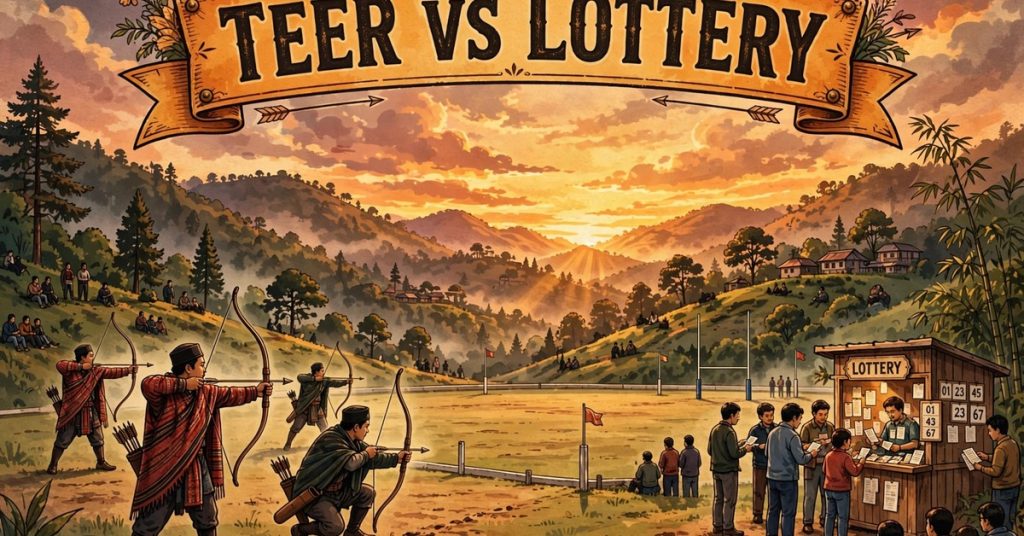
Shillong is the beating heart of teer, and there is no better place to understand the teer vs lottery question. Here the game is not an abstraction. It happens every playing day at the Polo Ground, where fifty archers shoot and a crowd watches. Compare that with a state lottery draw, which happens in a supervised room far from any crowd, and the difference between the two games becomes something you can feel, not just read about.
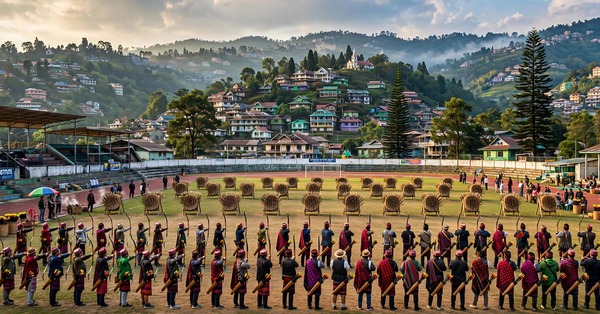
Teer vs Lottery – Seen From Shillong
Ask a Shillong local to explain teer and they will probably point you toward the Polo Ground rather than hand you a rulebook. The game belongs to a place. It is run by the Khasi Hills Archery Sports Association, an organization of local archery clubs, under a Meghalaya license that dates to the Amusements and Betting Tax (Amendment) Act of 1982. The archers come from the surrounding hills. The counters dot the city’s neighborhoods. The Sunday pause honors the community’s day of worship.
Now ask that same local about a lottery draw. They will describe something distant: a machine, officials, published numbers. Nothing to visit, nobody to watch, no ground to stand on. That contrast, place versus procedure, is the soul of this comparison.
The Polo Ground – Where Numbers Are Born
A field, not a machine room
The Polo Ground sits in the middle of Shillong, and on playing days it transforms into teer’s main stage. Fifty archers take their positions. In the first round each shoots 30 arrows at a large straw target. In the second round each shoots 20 arrows at a smaller target. The distance is 50 to 60 yards, serious archery by any standard.
After each round, officials collect and count every arrow that stuck in the target. The last two digits of the total become the winning number. If 1,356 arrows hit (example only, not a real result), the number is 56. The counting happens in the open, in front of spectators who have strong opinions about everything.
Why the venue matters
A lottery draw’s venue is deliberately forgettable: a room, a machine, witnesses (how lottery draws work). It has to be forgettable, because the draw’s fairness comes from procedure, not atmosphere. Teer’s venue is the opposite. The Polo Ground’s atmosphere is part of the product. Players trust the game partly because they can stand ten meters from the counting and watch.
The People – Archers vs Officials
Teer’s athletes
The archers are the game’s engine and its pride. Drawn from the association’s member clubs, they shoot for daily wages and club honor. Their skill is genuine: hitting a straw target repeatedly from 50-plus yards with traditional equipment takes years of practice. On shooting days the clubs rotate, so the lineup changes and followers debate which clubs shoot best in rain or wind.
Lottery’s administrators
A lottery draw has no athletes. It has officials who operate the machine, witnesses who verify the procedure, and publishers who release the numbers. Their job is to be invisible. The best lottery draw is the one nobody remembers, because nothing unusual happened.
What this means for players
Teer players develop loyalties and theories about people. Lottery players develop habits about tickets. One game gives you characters. The other gives you paperwork.
The Rituals – Dreams, Clubs and Weather
Shillong’s teer culture
Around the Polo Ground game has grown a rich culture. Dream-number charts translate dream symbols into two-digit picks. Players argue about club form the way football fans argue about teams. Weather matters because wind moves arrows, so a rainy forecast changes the conversation at every counter. Ticket sales open in the morning at roughly 5,000 authorized counters across the state’s 11 districts, with denominations from 1 to 100 rupees, and the city hums with speculation until the afternoon rounds.
Lottery’s thin culture
Lottery culture is thinner by design. You buy a printed ticket for a few rupees, choosing from the day’s named draws, and wait. There are lucky sellers and favorite days, but no equivalent of debating the archers. The machine gives you nothing to discuss.

How Results Differ – Counted vs Drawn
Shillong teer’s two numbers
Every playing day, Monday to Saturday, the main Shillong session produces two numbers: the First Round and the Second Round. Morning and night Shillong sessions add more. Each number is the last two digits of a hand-counted arrow total. Results reach followers within the hour, and you can always find the latest on our Shillong teer result page or the full teer result list.
A lottery’s drawn numbers
A state lottery draw produces its winning numbers from a machine in one supervised event. The Dear Lottery runs three such draws daily, each a separate lottery with tiered prizes topped by 1 crore rupees. Results are published officially and later gazetted. One ticket, one draw, one outcome.
Money – Fixed Multiples vs Jackpots
What a Shillong teer win pays
Teer payouts are fixed multiples of your stake: about 80 times for a correct first-round number, about 60 times for the second round. A 10-rupee ticket on the right first-round number pays roughly 800 rupees. Combined bets on both rounds pay far larger multiples. You know the prize before you play, and it never changes with the crowd size.
What a lottery win pays
Lottery prizes are tiered: 1 crore rupees at the top, then descending prizes down to small tiers plus a 1,000-rupee consolation. The multiples are enormous because the odds are one in millions. Most tickets win nothing.
The local economy angle
Teer money stays visibly local: counter commissions, club support, archer wages, state tax. In Shillong you can practically see where it goes. Lottery money flows to the organizing state’s treasury, distant and abstract. Both are legitimate. Only one feels like your neighborhood.
Law – One State’s Tradition vs Thirteen States’ Choice
Teer is legal in Meghalaya under the state’s 1982 law (Meghalaya government portal). Lotteries are legal in about thirteen Indian states under the national Lotteries (Regulation) Act of 1998 (lottery regulation background), and banned in the rest. Shillong’s game cannot simply be exported to a state that bans lotteries, and lottery tickets cannot simply be sold where they are banned.
For players the rule is plain. In Shillong, play teer at licensed counters. Elsewhere, check whether your state permits lotteries before buying any ticket. Online sellers offering either game outside licensed channels are not legitimate. Both games are 18 plus only.

Teer vs Lottery – A Playing Day in Shillong
To feel the teer vs lottery difference in your bones, spend a playing day in Shillong. No article can fully replace it, but here is the closest print can get.
Morning in the counters
The day starts quietly. Shutters roll up on teer counters across the city, from Police Bazar to the residential lanes. Regulars drift in with numbers already chosen. Some carry dream charts folded in pockets. Some just say the number like an old friend’s name. The counter agent writes, stamps, and moves on. There is no hard sell and no ceremony. This is routine, like buying the morning paper.
By late morning the first numbers of the day arrive from the morning markets, and the conversation shifts. Someone was close. Someone hit. The city processes it the way other cities process cricket scores.
Afternoon at the Polo Ground
The main session is the day’s center of gravity. At the Polo Ground, fifty archers prepare while spectators find their spots. There is a particular sound to a teer round: the soft thunder of dozens of bows releasing, then the murmur of the crowd doing its own arithmetic. How many stuck? What could the last two digits be?
Then the counting, done by hand in the open, officials moving along the targets while everyone watches. When the First Round number goes up, half the crowd groans and half leans forward for the second. The Second Round repeats the ritual: shooting, counting, the number. By late afternoon it is over, and the city exhales.
Evening in the tea shops
After the main session, the day is not done. Juwai and Khanapara hold their sessions, and the night markets follow. Tea shops fill with the second postmortem of the day. This is where the skill vs luck teer debate lives most vividly: was it the wind, the club rotation, or just the day? Nobody resolves it. Everybody enjoys it.
What a lottery day lacks
Now imagine the same city with only a lottery. Tickets bought in silence. A draw in a distant room. Numbers published online. There would be no ground to visit, no crowd to join, no tea-shop debate. Efficient, certainly. But Shillong would lose something it clearly loves. The difference between teer and lottery is not only structural. It is atmospheric.
Teer vs Dear Lottery Through Local Eyes
Ask Shillong residents about the teer vs dear lottery question and you get answers no rulebook contains.
“Teer is ours”
The most common sentiment is ownership. Teer grew from Khasi archery, is run by the Khasi Hills Archery Sports Association, and employs local archers. When residents defend teer against criticism, they defend a community institution, not a betting product. The lottery, however legitimate, is always “theirs”: organized elsewhere, drawn elsewhere, benefiting elsewhere.
“The lottery is for dreaming big”
Locals are clear-eyed about the lottery’s appeal. Nobody pretends the Dear Lottery’s 1-crore first prize is likely. But the dream has its place. Teer players buy lottery tickets too, often for festivals or family occasions, treating them as a different kind of purchase: not the daily game, but the occasional moonshot.
“You can see teer”
Trust comes up constantly. Residents point out that they can watch the archery and the counting with their own eyes. The lottery’s supervised procedure is respected but distant. An archery lottery vs lucky draw comparison, in local terms, is a comparison between something you witness and something you are told.
What visitors should know
If you visit Shillong, watching a session at the Polo Ground is worthwhile even if you never place a bet. It is one of India’s most unusual sporting spectacles. Buy a ticket only at a licensed counter, only if you are 18 or older, and only with money you can lose. And if anyone near the ground offers “confirmed numbers,” remember you are in the one place where everyone should know better.
The teer lottery comparison locals make
The teer lottery comparison you hear in Shillong is refreshingly unsentimental. Teer is the daily bread: small stakes, frequent results, community ritual. Lottery is the festival sweet: rare, rich, separate. Both have their season. Neither replaces the other. It is probably the healthiest attitude toward number games anywhere in India.
Teer vs Lottery – The One-Paragraph Version for Visitors
If a friend visits Shillong and asks you to explain the whole teer vs lottery thing before the afternoon session, here is the paragraph. Teer is Meghalaya’s licensed archery betting game: you pick a two-digit number, fifty archers shoot two rounds at the Polo Ground, officials count the arrows, and the last two digits win, paying fixed multiples of your stake. Lottery is the state-run alternative: you buy a pre-printed ticket, a supervised machine draws the winners, and tiered prizes run up to 1 crore rupees. Teer is a community event you can watch. Lottery is an administrative event you check. Both are legal where permitted, both are for adults, and both keep your stake more often than not. That paragraph covers ninety percent of what anyone needs.
What should a visitor not do?
Do not buy “teer tickets” from anyone who approaches you near tourist spots. Licensed counters are fixed shops, not roaming sellers. Do not pay for number tips. Do not assume the game works like a lottery back home. And do not photograph the archers’ faces without asking. Respect the ground and it will give you a great afternoon.
Is there a best day to watch?
Playing days run Monday to Saturday, and the main afternoon session draws the biggest crowd. Arrive a little early, find a spot with a view of the targets, and stay for both rounds. The counting between rounds is half the show.
Frequently Asked Questions
Where exactly is teer played in Shillong?
The main session is conducted at the Polo Ground in Shillong by the Khasi Hills Archery Sports Association. Tickets are sold at around 5,000 authorized counters across Meghalaya’s 11 districts. Spectators can watch the archery and counting at the ground on playing days.
Is teer a lottery under the law?
In Meghalaya, yes. It is licensed under the Meghalaya Amusements and Betting Tax (Amendment) Act, 1982, which treats it as a legal lottery-style game. In practice it works like a sport with betting, which is why it feels so different from a machine-drawn lottery.
How is a Shillong teer number decided?
Fifty archers shoot at straw targets, 30 arrows each in the first round and 20 each in the second, from 50 to 60 yards. Officials count the arrows that hit the target, and the last two digits of the total become the winning number for that round.
Why does Shillong teer close on Sundays?
It is a long-standing community tradition honoring the day of rest and worship. The main session runs Monday to Saturday. State lotteries have no such pause and draw every day.
Can visitors watch teer at the Polo Ground?
Yes. The sessions are public, and watching the archery and the hand counting is the best way to understand the game. It is also the best answer to anyone who wonders whether the results are genuine.
How do teer payouts compare with lottery jackpots?
Teer pays fixed multiples, roughly 80 times your stake for a first-round win, at 1-in-100 odds per round. Lotteries pay tiered prizes up to 1 crore rupees at one-in-millions odds. Teer offers frequent modest wins. Lottery offers rare enormous ones.
Does the weather really change teer results?
Wind and rain genuinely affect archery, so conditions influence how many arrows hit the target. What they do not do is change the result predictably. A windy day moves the total, but the last two digits of that total remain extremely hard to forecast. Weather is worth watching for enjoyment, not for profit.
Why Shillong Settles the Debate
You can argue teer vs lottery in the abstract forever. Or you can stand at the Polo Ground one afternoon, watch fifty archers shoot, hear the crowd react to the counting, and understand instantly. Teer is a community event that produces numbers. A lottery is an administrative event that produces numbers. Both are legal games of chance for adults. Only one of them smells like rain on a field. For the numbers themselves, every market every day, start at the Shillong Teer Result homepage and keep the Juwai teer result page handy if you follow that market too.