
Every teer player has the same moment sooner or later: you need a juwai teer previous result and you need it now. Maybe you missed the morning session and want to confirm what was declared. Maybe you are settling a friendly debate about last week’s numbers. Or maybe you keep a personal record book and want to fill a gap. Whatever the reason, the Juwai archive is the place to look, and knowing how it is organized saves you from the most common mistake of all: reading the wrong market’s history and thinking it belongs to Juwai.
Juwai Teer is the archery lottery of Jowai town in the West Jaintia Hills of Meghalaya, run by local clubs under the same legal framework that governs teer across the state. It runs morning and day (afternoon) sessions on game days, Monday to Saturday, with two rounds per session called FR (first round) and SR (second round). Every declared round produces a two digit number from 00 to 99, and every one of those numbers is preserved in the previous result archive. This guide explains how the Juwai archive works, how to find any past declaration by date, how to read an entry correctly, and how the Juwai history differs from the Shillong and Khanapara archives that players often confuse it with.
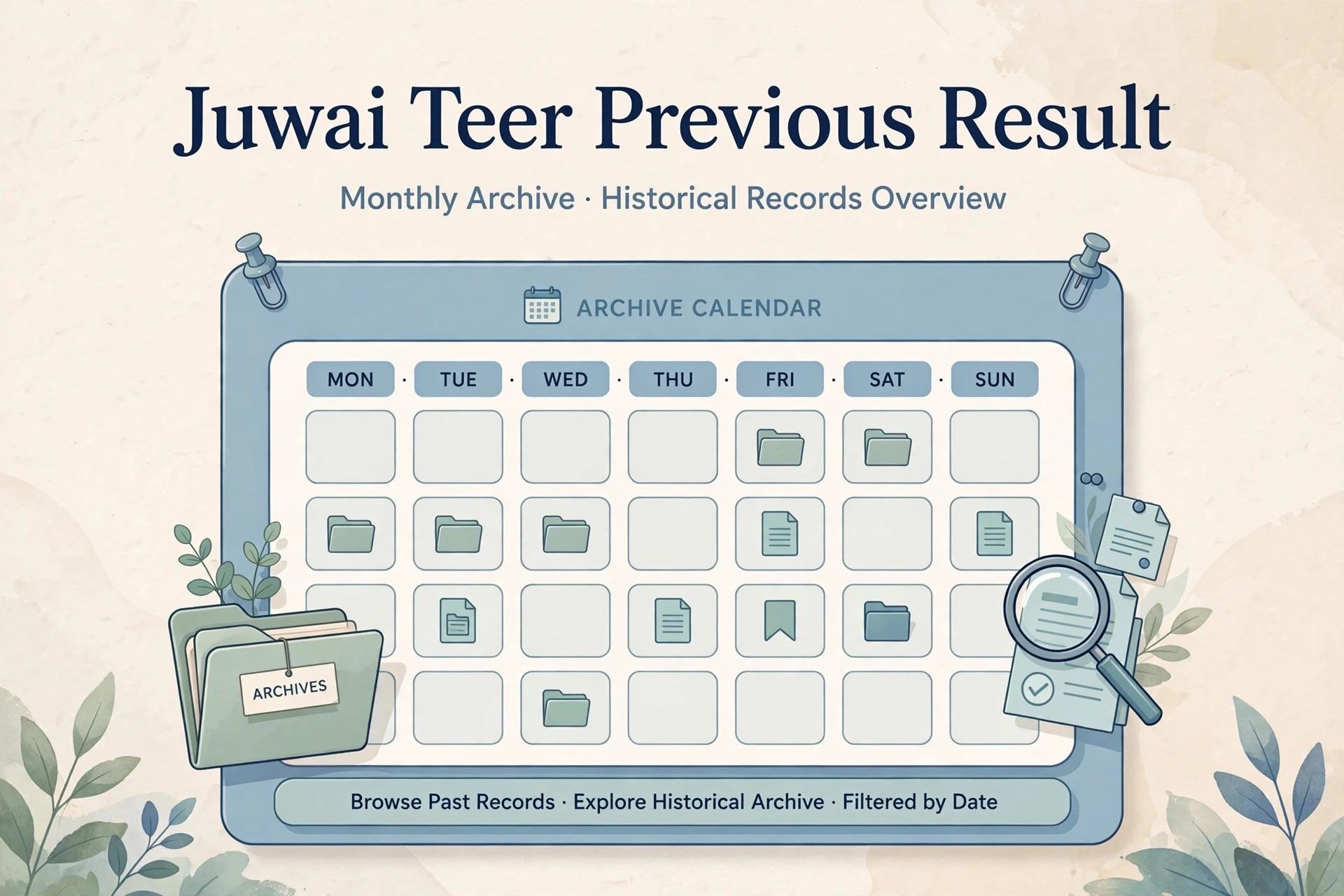
What the Juwai Teer Previous Result Archive Actually Is
The archive is a dated record of every officially declared Juwai round, nothing more and nothing less. Each game day contributes up to four numbers: morning FR, morning SR, day FR, and day SR. Sundays contribute nothing, because teer does not run on Sundays, and the archive correctly shows a gap for every Sunday. Public holidays can also create gaps, and a well kept archive marks those days clearly instead of leaving players to guess.
It helps to understand what the archive is not. It is not a prediction tool. Past Juwai numbers describe what the archers shot on those days; they say nothing about what the archers will shoot tomorrow, because each round is an independent event. The archive is also not a live page. If you need today’s numbers, the Juwai teer result page carries the current declarations, while the archive is where you go for everything before today.
Archives are maintained in two forms. The primary form is the date ordered list, where each row is one game day and the columns are the four rounds. The secondary form is the session view, where morning and day histories are shown separately for players who follow only one session. Both draw from the same declarations, so a morning FR number in the date list and the same number in the morning view will always match. If they ever disagree, one of the two pages has a data error, and the date list is the one to trust while the error is fixed.
Juwai Teer Previous Result – Morning and Day Sessions Explained
Juwai runs two sessions a day, and the archive keeps them strictly separate. The morning session is the early game: its FR is typically declared around mid morning and its SR follows about an hour later. The day session, sometimes called the afternoon session, is the main Juwai game: its FR is typically declared in the early afternoon and its SR follows in the mid afternoon. All times are approximate and stated in Indian Standard Time, and exact minutes can shift slightly from day to day.
This separation matters because the two sessions are independent games within the Juwai market. The morning archers and the day archers shoot at different times, under different conditions, and their counts have no mathematical relationship. A morning FR of one number tells you nothing about what the day FR will be. When you look up a juwai teer previous result, always confirm which session you are reading. Archive mix ups between morning and day columns are among the most common errors players make, and they are entirely avoidable once you know the layout.
The morning session tends to get less attention than the day session, which means its archive is consulted less often but is just as complete. If you play the morning game, bookmark the morning view specifically rather than scrolling the combined list each time. The day session archive is the busier one: more players, more tickets, and more lookups. Both are maintained to the same standard, and a missing entry in either one is worth reporting to the site rather than assuming the round never happened.
For players who follow Juwai alongside Shillong, note that the two markets run on similar but not identical clocks. Juwai’s day FR typically declares before Shillong’s afternoon FR, which is why experienced multi market players check Juwai first in the early afternoon and Shillong later. The archives reflect this ordering, and comparing the two histories side by side is a good way to learn the rhythm of the teer day.
How to Find Any Juwai Teer Previous Result by Date
Finding a specific past declaration is straightforward once you know the archive’s navigation. Start from the teer result list page, which organizes declarations by date across all markets. Select or scroll to the date you need, then look at the Juwai section of that day’s row. The four rounds will be listed with their declared numbers, or with a placeholder mark if you are somehow viewing a day whose declarations were never completed, which should not happen for past dates.
If you need a range of dates, for example the whole of last week, work backwards from today one game day at a time and skip Sundays. A useful habit is to note the day of the week alongside the date in your own records, because “last Tuesday” is easier to locate than a bare date when you are scanning a long list. Monthly views, where available, compress each week into a compact grid and are ideal for spotting the Sunday gaps at a glance.
Sometimes a player needs a previous result for an administrative reason: a ticket dispute, a record book audit, or a simple memory check. In these cases, take a screenshot of the archive entry showing the date, and keep it with your records. Archive pages can be updated if a data correction is ever needed, so a dated screenshot preserves what you saw. For anything involving money, however, the licensed counter’s own records are the authority, not a website archive. The archive is a convenience and a cross check; the counter’s books settle disputes.
One more practical tip: archive pages load fastest when you navigate directly to the date rather than scrolling through months of history on a single page. If the site offers a date picker or month selector, use it. And if you find yourself looking up the same date repeatedly, bookmark it. Regular players often keep three bookmarks: today, yesterday, and the first of the month, which covers the vast majority of lookups.

Reading a Juwai Archive Entry – The Four Checks
An archive entry is small, but it carries four pieces of information and you should verify all four every time. First, the date: confirm the day, month, and year match the day you are researching. Archive pages sometimes show adjacent days on the same screen, and reading the row above or below your target is an easy slip. Second, the market label: confirm it says Juwai, not Shillong or Khanapara. Multi market pages place the markets side by side, and the columns look similar at a glance.
Third, the session: confirm whether the number sits under morning or day. As discussed above, these are independent games and their numbers are not interchangeable. Fourth, the round: confirm FR versus SR. Your ticket is tied to a specific round, so an FR number never settles an SR ticket, even when both belong to the same session on the same day.
The number itself is always two digits, from 00 to 99, with a leading zero preserved where needed. A result of five is written as 05, never as 5. This convention matters when you compare the archive with your own notes: if your notebook says 5 and the archive says 05, they agree. Leading zeros are part of the official format, not decoration.
Placeholders deserve a final word. On a current or recent day, you may see a dash where a round has not been declared yet. On a genuinely past date, every round should show a number, because every past game day is complete. If you ever see a dash on a date more than a day old, treat it as a data gap and check a second source or ask the site about it. A complete archive has no dashes in the past.
Juwai Teer Previous Result vs the Shillong and Khanapara Archives
Juwai, Shillong, and Khanapara are three separate games with three separate archives, and keeping them distinct is the single most important archive skill a teer player can learn. The games share a format: archery, two rounds, two digit results. Everything else is independent: different towns, different clubs, different archers, different schedules, and different numbers. A Shillong previous result never substitutes for a Juwai one, and a Khanapara number never settles a Juwai ticket.
The confusion usually starts with the layout. Archive pages that cover all markets show the three games in adjacent columns, and a tired eye can easily read across into the wrong column. The defense is labeling: when you copy a number into your own records, always write the market name next to it. “Juwai day FR” is unambiguous; a bare two digit number is not. Players who keep market labeled records essentially never suffer archive mix ups.
The schedules also differ in ways that help you tell the archives apart. Juwai’s day session declares earlier in the afternoon than Shillong’s main session, and Khanapara’s afternoon session has its own window near Guwahati. If you know the approximate declaration order, an archive entry that seems out of sequence is a signal to double check the market label. The Shillong teer result page is the reference point for the Shillong archive if you ever need to compare the two histories directly.
There is one more subtle difference worth knowing. Juwai is a smaller market than Shillong in terms of player volume, which means its archive gets less scrutiny from the crowd. Errors in a Juwai entry can survive longer before someone notices. If you are a dedicated Juwai player, you are part of the quality control: when an entry looks wrong, reporting it helps every Juwai follower. The archive is a shared resource, and its accuracy depends partly on the players who use it most.

Using Past Juwai Results Responsibly – A Record, Not a Forecast
This section matters more than any other in this guide, because it addresses the most persistent misunderstanding about previous results. A juwai teer previous result is a historical record. It tells you what happened. It does not tell you what will happen. Each round of archery is an independent event: the archers, the arrows, the wind, and the light are all fresh every time, and no pattern in past numbers influences the next count. This is not a matter of opinion; it is how the game is physically constructed.
Despite this, a small industry of so called analysis tries to sell the opposite idea: that past Juwai numbers contain hidden patterns, that certain numbers are “due,” or that a chart of previous results can predict the next declaration. None of this has any basis in the game’s mechanics. The people selling such analysis are selling fiction, and the sites that publish “common numbers” or “hit numbers” derived from archives are publishing guesses dressed as insight. This site publishes no prediction content of any kind, and you should treat any source that does as entertainment at best and fraud at worst.
So what are previous results actually good for? Plenty, within their honest limits. They let you verify what was declared on a day you missed. They let you audit your own record book for accuracy. They let you learn the rhythm of the game: typical declaration times, the Sunday gaps, how FR and SR relate in timing (not in value). They let you settle debates with friends using facts instead of memory. And they give new players a feel for the game’s format before they ever buy a ticket. All of these are legitimate, useful purposes, and none of them require pretending the past predicts the future.
If you enjoy studying the archive as a hobby, do it with clear eyes. Notice how often each two digit value appears over a month, and you will see what randomness looks like: some values appear a little more, some a little less, and none of it means anything for tomorrow. That observation is itself valuable. It trains you to recognize the difference between a real pattern and a coincidence, which is a skill that protects you far beyond teer.
Teer is a legal lottery in Meghalaya for adults aged 18 and above, and it should be approached as paid entertainment, not as income. If you ever feel that studying previous results is turning into a compulsion, or that you are spending more than you can afford chasing a pattern, step back and talk to someone you trust. The archive will still be there when you return to it with a clear head.
The Juwai Teer Result List – Weekly and Monthly Views
Beyond the day by day lookup, the archive offers broader views that serve different needs. The weekly view shows six game days in one screen, Monday through Saturday, with the Sunday gap visible as a blank column. This is the best view for players who audit their week: you can scan all four rounds across all six days and spot any day you missed in seconds. It is also the view that most clearly shows the game’s weekly rhythm, which helps new players internalize the schedule.
The monthly view compresses roughly twenty six game days into a grid. Individual numbers become small, but the structure becomes clear: the regular columns of declarations, the blank Sundays marching down the grid, the occasional holiday gap. Monthly views are most useful for record keepers who maintain their own books and want to reconcile a full month at a glance. If your notebook and the monthly grid agree on every entry, your records are solid.
When using these broader views, remember that compression hides detail. A monthly grid will not show you the exact declaration time of a round, only the number. If you need the full entry with timestamps, drill down to the daily view for that date. And as always, confirm the market label: in a compressed grid, the Juwai section and the Shillong section sit close together, and the habit of checking the header before reading the numbers will serve you well.
For players who track Juwai across long periods, consider exporting or saving the monthly views that matter to you. Websites redesign, URLs change, and archives migrate. Your own saved copies, screenshots, or printed pages are immune to all of that. Keep them organized by month and year, and you will have a personal Juwai history that no site change can take away.
Frequently Asked Questions
Where can I find the juwai teer previous result for a specific date?
Use the teer result list archive and navigate to the date you need, then read the Juwai section of that day’s entry. Each game day shows morning FR, morning SR, day FR, and day SR. Skip Sundays, because no teer is played on Sundays and the archive correctly shows no entries for those days.
Does the Juwai archive include both morning and day sessions?
Yes. A complete juwai teer previous result entry covers all four rounds: morning FR, morning SR, day FR, and day SR. The two sessions are independent games within the Juwai market, so always confirm whether the number you are reading belongs to the morning or the day column before using it.
Can previous Juwai results help predict future numbers?
No. Each round of archery is an independent event, and past numbers have no influence on future declarations. The archive is a historical record for verification and record keeping, not a forecasting tool. Any site offering predictions based on previous results is not describing how the game works.
Why is there no Juwai entry for Sunday in the previous result list?
Teer is not played on Sundays. The archers, counters, and associations all observe Sunday as a holiday, so no rounds are shot and no numbers are declared. The gap in the archive for every Sunday is correct and expected, not a data error.
What should I do if a past date shows a dash instead of a number?
On a genuinely past date, every round should show a declared number, because every past game day is complete. A dash on an old date indicates a data gap. Check a second source, and consider reporting it to the site so the archive can be corrected. Do not treat the dash as a result.
Are Juwai previous results the same as Shillong previous results?
No. Juwai and Shillong are separate games with separate archers, schedules, and declared numbers. Their archives are completely independent. Always confirm the market label on an archive entry, and never use a Shillong number in place of a Juwai one or vice versa.
How far back does the Juwai previous result archive go?
The archive maintains an extensive history of past declarations, organized by date. For very old records beyond the online archive’s range, licensed counters and association offices are the fallback sources. For most practical purposes, from settling recent tickets to auditing a month of play, the online archive covers what you need.
Is it legal to access and use previous teer results?
Yes. Teer is a legal, state regulated lottery in Meghalaya, and its declared results are public information. Accessing the archive is completely lawful. The game itself is strictly for adults aged 18 and above, and all play should be responsible. Official state information is available on the Meghalaya government portal, and background on the region is on Wikipedia’s Jowai page.
Conclusion
The juwai teer previous result archive is one of the most useful tools a Juwai player has, provided it is used for what it is: a faithful record of declared history. Learn its layout, respect the separation of morning and day sessions, always verify the market label, and use it to keep your own records honest. Treat it as a reference library rather than a crystal ball, and it will serve you well for years. The archers of Jowai shoot fresh every game day; the archive remembers every shot, and now you know exactly how to read its memory.
Teer is a legal lottery in Meghalaya for adults aged 18 and above. Play responsibly.