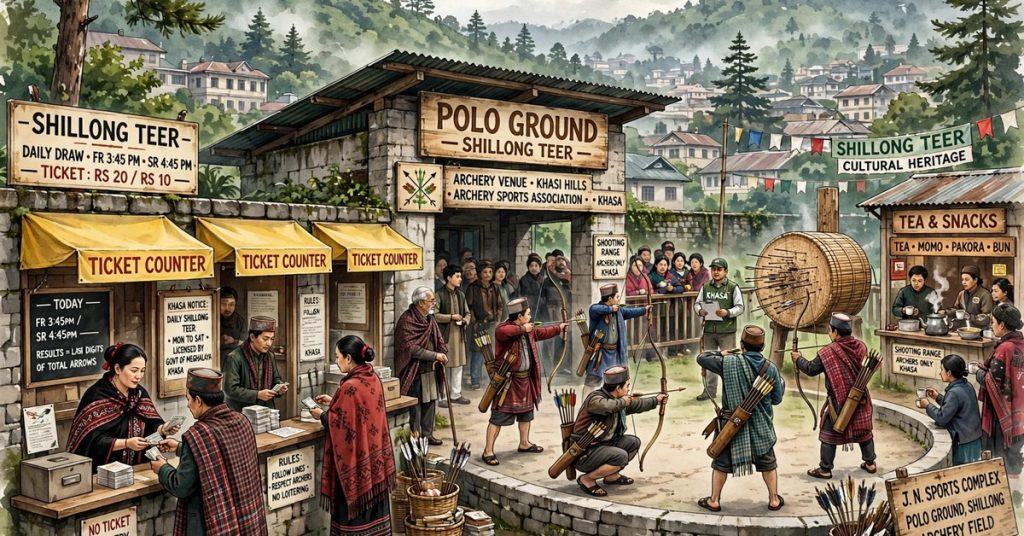
Some histories are best told as a story. Others are best told as a list. The question “when did shillong teer start” has so many partial answers that a list of milestones is the clearest way to hold them all at once. Each milestone below is a moment when the game changed shape: a tradition born, a bet placed, a law passed, a system invented. Some milestones are centuries wide. Some are a single day. Together they answer every version of the question.
Read them in order and you will watch a Khasi village pastime become a legal lottery. For today’s chapter of the story, the live numbers, visit Shillong Teer Result.

Context for the curious: the Shillong page on Wikipedia covers the city, and the Meghalaya government portal is the state’s official site.
When Did Shillong Teer Start: 14 Milestones That Built the Game
Milestone 1: Centuries Ago, Khasi Archery Takes Root
The deepest milestone has no date. The Khasi people of the hills around Shillong made the bow a way of life: hunting, village defence, then festival sport. Boys learned young. Contests drew crowds. This archery tradition is the foundation under everything else in the timeline. Without it, there is no game to bet on and no lottery to legalise. The old names survive as proof of this depth: Thoh Tim and Siat Khnam, the Khasi names for the archery game, predate the lottery by generations.
Milestone 2: The Early 1900s, the First Bets
Sometime in the early 20th century, spectators at village archery contests began staking bets on the outcomes. The first stakes were humble: betel nut and leaf, known as Kwai, wagered in a spirit of friendly recreation called KaRongbiria. Nobody recorded the year. The habit crept in village by village, contest by contest, until betting was simply part of the scene. What makes this milestone fascinating is how innocent it was. The first teer economy ran on chewing tobacco’s companion, not cash. The transformation from recreation to business took decades, and it happened so gradually that no single generation noticed the moment the game changed.
Milestone 3: 1952-53, the First Written Record
The mist clears in 1952-53. That is the date of the first written record of people betting on archery in Shillong, cited by the leadership of the Khasi Hills Archery Sports Association. By this point, clubs from villages and localities around the town were holding regular contests, and the betting was organised enough to leave a trace. This is the oldest hard date in the teer game beginning. Note what it implies: if betting was organised enough to be recorded in 1952-53, the unrecorded years stretched well before it. The record is a floor, not a ceiling. The real start of the betting lies somewhere in the early-1900s mist of Milestone 2.
Milestone 4: The 1950s, Twelve Clubs Under One Board
As the sport grew, 12 active archery clubs began competing against each other in an organised way. They were governed by the Archery Board Control, the ABC, the direct ancestor of today’s Khasi Hills Archery Sports Association. Clubs from Malki, Laitumkhrah, Mawlai and other localities formed the competitive backbone of the game. The 12-club structure created in this decade still runs the sport. Two clubs shoot each day from Monday to Friday, and archers from all the clubs shoot together on Saturdays, a rotation designed so no single group controls the outcome. When you see that system in action today, you are watching a 1950s invention at work.
Milestone 5: The Late 1950s, the Two-Digit System Is Born
The cleverest milestone of all. In the late 1950s, the competition took its present form when a unique system of adapting the results to the requirements of gambling emerged. Officials began counting the arrows embedded in the target, and the last two digits of the count became the winning number. As an example only, not a real result: 1,043 arrows in the target means the number 43. One hundred numbers, from 00 to 99, in play every round. Modern teer was born here. The economics fell into place around the idea: a minimum stake as low as Re 1, a single-number payout of 80 to 1, and a forecast payout of 4,000 to 1 for calling both rounds. That pricing, invented in a Shillong field in the late 1950s, still governs the game today.
Milestone 6: The Late 1960s, Popularity Brings the Police
The late 1960s were when archery betting got really popular in Shillong, and popularity brought trouble. Meghalaya was still part of Assam, and the Assam government wanted the betting banned. Police were given authority to arrest bookies. The archery continued openly at the grounds. The betting went underground. The game learned to survive as an outlaw. Picture the Polo Ground on a weekday afternoon in 1968: archers shooting at the hay target, crowds watching, and money changing hands quietly somewhere in the crowd, because the man taking the bet could be arrested before the round ended. The players knew the risks. They played anyway.
Milestone 7: 1970, the Prevention of Gambling Act
In 1970, the Meghalaya Prevention of Gambling Act prohibited most forms of gaming in the state. Teer betting, already in the authorities’ sights, was now plainly illegal under statute. This law defined the darkest decade of the game’s history and set up the confrontation that the 1982 legalisation would resolve.
Milestone 8: 1972, Meghalaya Becomes a State
In 1972, Meghalaya was recognised as a separate state with Shillong as its capital. For teer, this changed who made the rules. The game was now governed from the city where it was played, not from distant Assam. The Khasi Hills Archery Sports Association began negotiating with the new state government for legalisation, starting the decade-long conversation that would end in 1982. The association’s argument was pragmatic and honest: the police could not stamp the game out, the underground trade was breeding crime, and regulation would serve everyone better than prohibition. It took ten years for the government to agree, but the path to 1982 started here.
Milestone 9: The 1970s, the Underground Decade
The 1970s were the roughest years in the shillong teer timeline. Police raids were frequent. The illegal trade attracted strongmen who rigged results and cheated players; one well-known account describes a don from Mawlai fixing the game while the authorities tried to stamp it out. Through it all, the archers kept shooting at the Polo Ground. The tradition outlasted the criminals. It is worth remembering that the Sunday no-betting competitions never stopped either. While the weekday game went underground, the pure sport stayed in the open, keeping the skills and the crowds alive for the legal era to come.
Milestone 10: 1981, the Ban Era Ends
Teer gambling had been banned until 1981. The end of the ban did not yet mean legalisation, but it marked the moment the state stopped treating the game purely as a crime. The negotiations between the archery association and the government, running since the 1970s, were approaching their conclusion. The ground was prepared, legally and politically, for the milestone to come.
Milestone 11: October 1, 1982, Legalisation Day
The milestone every timeline circles. On October 1, 1982, the proposal to legalise teer betting was approved, and the game came under the Meghalaya Amusements and Betting Tax (Amendment) Act, 1982. This is the teer legalisation year. Every bookie now needed a government license. Counters recorded daily earnings. A share of the proceeds funded the sport and paid the archers. The Khasi Hills Archery Sports Association took formal charge of the shooting roster, the counts, and the declarations. The outlaw game became an industry, and the Shillong Teer result became an official public record. The whispers became chalkboards. The back rooms became shopfronts.
Milestone 12: The 1990s and 2000s, Growth and Revenue
Legalisation opened the door to growth. Counters multiplied to an estimated 1,500 in Shillong and nearly 5,000 across the state. New centres like Khanapara rose near the Assam border, and the Jaintia hills developed their own games around Jowai. Morning sessions joined the classic afternoon game; players now follow the Shillong morning teer result too. By 2008-09, the state earned Rs 115.5 lakh a year from the game, with total turnover estimated up to Rs 750 crore. The village pastime was now a serious industry, and the licensed-counter model proved it could work far beyond the capital.
Milestone 13: 2018, the New Regulation Act
In 2018, the Meghalaya Regulation of the Game of Arrow Shooting and the Sale of Teer Tickets Act, 2018 updated the legal framework. It addressed how arrow-shooting sessions are organised and how teer tickets are sold, bringing the 1982-era rules into the modern age. The milestone proved the state still treats teer as a living, regulated institution, not a historical curiosity.
Milestone 14: The 2020s, the Digital Era
The latest milestone is the one you are living in. Results that once travelled by chalkboard and word of mouth now reach phones within minutes of each round. The daily result lists carry every centre’s numbers to players far beyond Meghalaya. Morning and night sessions, unimaginable in the Polo Ground’s early decades, now run alongside the classic afternoon game. The bamboo bow is unchanged. The audience is global. The milestones continue, and the next one will likely be written in code rather than on chalkboards.

When Did Shillong Teer Start: Putting the Dates Together
Fourteen milestones, one answer in layers. The tradition started centuries ago. The betting started in the early 1900s. The first record dates to 1952-53. The number system was born in the late 1950s. The legal lottery started on October 1, 1982. The modern framework was refreshed in 2018.
If someone asks you for a single shillong teer starting year, give them 1982, and then tell them the other dates. The milestones are the real story. The year is just the headline. And if they ask why there are so many dates, tell them what the milestones show: this game was never founded, it grew, and growing things do not have birthdays.
What the Milestones Teach Us About Teer
Step back from the list and patterns emerge. The first is that teer was never designed. No founder, no launch date, no business plan. It accreted: a tradition here, a betting habit there, a number system, a law. Games that are designed can be redesigned. Games that accrete have to be understood layer by layer, which is why the milestone format suits teer better than a single founding story.
The second pattern is the law following the culture, not leading it. Every legal milestone in the list is a reaction. The 1970 Act reacted to the popularity of the 1960s. The 1982 legalisation reacted to the failure of the 1970s prohibition. The 2018 Act reacted to the digital age. At no point did the law invent anything. It recognised, banned, or regulated what the culture had already built. That is worth remembering whenever someone treats the 1982 date as the whole story.
The third pattern is survival through adaptation. The bamboo bow gave way to nothing; it is still bamboo. But everything around it changed: betel nut became rupees, whispers became chalkboards, chalkboards became websites. The milestones show a tradition that bends without breaking, absorbing each new era’s tools while keeping its core ritual intact. That is why the timeline is still growing, and why Milestone 15 is a matter of when, not if.
Frequently Asked Questions About the Teer Milestones
Which milestone matters most in teer history?
Milestone 11, the legalisation of October 1, 1982, matters most for the game as it exists today. But Milestone 5, the invention of the two-digit number system in the late 1950s, matters most for the game’s identity. Without 1982, teer would still be illegal. Without the late 1950s, it would be a different game entirely.
Why are there so many possible starting years?
Because teer grew in layers. The archery tradition is centuries old. Betting began in the early 1900s. The first record is 1952-53. The number system dates to the late 1950s. The legal game began in 1982. Each date answers a different version of the question, which is why timelines list them all.
What happened between 1952 and 1982?
Thirty busy years. The late 1950s brought the two-digit system. The late 1960s brought popularity and the first ban attempts. 1970 brought the Prevention of Gambling Act. 1972 brought Meghalaya statehood. The 1970s brought the underground years of raids and rigged games. 1981 ended the ban era. Then came 1982.
Did anything important happen after 1982?
Yes. The 1990s and 2000s brought explosive growth in counters and revenue, plus new centres like Khanapara and new sessions like the morning game. In 2018, the Meghalaya Regulation of the Game of Arrow Shooting and the Sale of Teer Tickets Act modernised the legal framework. The 2020s brought the game fully online.
Where can I see these milestones in real life?
Visit the Polo Ground in Shillong. The ground has hosted archery through every milestone from the 1950s onward, and traditional no-betting competitions are still held there on Sundays and during festivals. The licensed counters lining Shillong’s streets are the living legacy of the 1982 milestone.
Are the milestone dates certain?
The key legal dates, 1970, 1972, October 1, 1982, and 2018, are matters of public record. The 1952-53 betting record comes from the archery association’s own leadership. The early-1900s start of betting and the late-1950s emergence of the number system are the consensus of historical reporting. The centuries-old origin of Khasi archery belongs to oral tradition.
Will there be a Milestone 15?
Almost certainly. The game keeps evolving: new sessions, new centres, new technology, possibly new regulation. The milestone list is open-ended. The next one might be written this decade.
The List Is the Story
Fourteen milestones, and each one earned its place. The bow, the bet, the record, the clubs, the number system, the ban, the law, the state, the underground, the thaw, the legalisation, the growth, the update, the internet. Read the list again and notice how each milestone answers the one before it. The ban answers the popularity. The legalisation answers the ban. The growth answers the legalisation.
So when did shillong teer start? It started fourteen times, once per milestone. The fullest answer is the whole list, and now you have it. Keep this page bookmarked: every time the game adds a new chapter, a new session, a new centre, a new law, it earns another milestone, and this timeline is ready for it.
A closing note: teer is a legal lottery in Meghalaya for adults aged 18 and above only. Play responsibly, set your limits, keep it fun, and enjoy being part of a story that is still adding milestones.