Readers often treat Shillong Teer and Khanapara Teer as one game, and that misunderstanding causes more archive errors than any other. A khanapara teer previous result belongs to the Khanapara game, played near Guwahati in Assam. Shillong Teer is a separate game, played in Shillong, Meghalaya, with its own archers, its own schedule, and its own history of declared numbers. This guide compares the two archives side by side, explains exactly how they differ, and shows you how to keep their records cleanly separate so you never mix one game’s history with the other’s.
Both games share the same basic format: archery based lottery, two rounds per playing day called FR (first round) and SR (second round), one two digit number from 00 to 99 declared per round. The format is the same, but everything else, the place, the people, the timing, and the numbers, is independent. Understanding that independence is the key to using both archives correctly.
Two Games, Two Histories
Shillong Teer is played in Shillong, the capital of Meghalaya, and it is the older and more widely followed of the two games. Khanapara Teer is played at Khanapara, on the Assam side near Guwahati. Each game has its own teer ground, its own organizing association, and its own set of archers. When the archers at one ground shoot, nothing about the other ground’s shooting changes. The two events are physically and administratively separate.
Because the games are separate, their histories are separate. The Shillong archive records what Shillong’s archers produced on each date. The Khanapara archive records what Khanapara’s archers produced. A number declared in Shillong on a given date has no relationship to the number declared in Khanapara on the same date. They are two independent facts that happen to share a calendar day.
This separation extends to the sessions. Both games run morning and afternoon sessions, each with FR and SR rounds. So on a full playing day, there are actually eight distinct numbers across the two games: Shillong morning FR and SR, Shillong afternoon FR and SR, Khanapara morning FR and SR, and Khanapara afternoon FR and SR. The Shillong Teer Result homepage network keeps these in clearly labeled sections, and your job as a reader is to open the section matching the game you mean.
Khanapara Teer Previous Result – How the Khanapara Archive Differs From Shillong’s
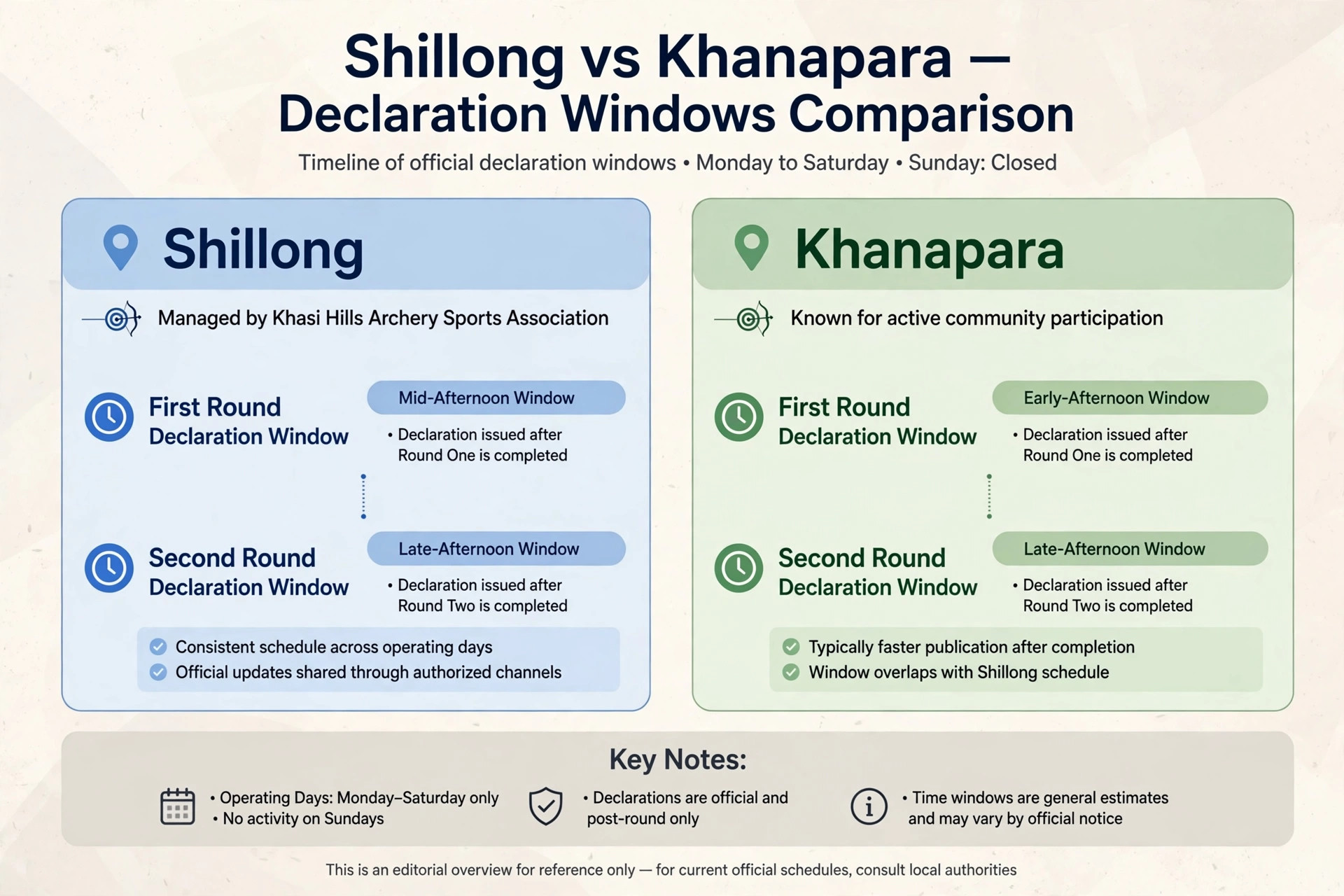
Side by side, the two archives look similar: date wise rows, FR and SR columns, newest first ordering. The differences are in the details. First, the declaration schedule differs. Shillong’s afternoon rounds are typically declared earlier in the afternoon, while Khanapara’s afternoon rounds follow later. This means that on any given day, the Shillong archive for that date is usually complete before the Khanapara archive is. If you check both archives in the mid afternoon, you may find Shillong’s numbers present and Khanapara’s still pending. That is normal scheduling, not a data problem.
Second, the holiday calendars can differ slightly. Both games rest on Sundays, but local holidays and special circumstances may suspend one game while the other plays. An archive row that is blank for Khanapara on a date when Shillong shows numbers is not an error. It reflects the two games’ independent schedules. Always interpret blanks within each game’s own calendar.
Third, the depth of history may differ between archives. One site’s Shillong archive might stretch back further than its Khanapara archive, or vice versa, depending on when each section was started. A shorter history for one game does not indicate unreliability. It simply reflects when systematic record keeping began for that section.

Declaration Timings Compared
Timing is where the two games’ daily rhythms become visible. Shillong Teer’s afternoon session declares its first round around the mid afternoon and its second round later in the afternoon. Khanapara Teer’s afternoon session declares its first round in the late afternoon and its second round toward the evening. The morning sessions follow a similar pattern earlier in the day, with Shillong’s morning rounds declared around late morning and Khanapara’s morning rounds around midday.
These are approximate windows, not exact appointments. Declaration times can shift with weather, ground conditions, and administrative factors. Treat the schedule as a rhythm rather than a timetable. The practical consequence for archive users is ordering: when you check in the late afternoon, expect Shillong’s numbers first and Khanapara’s after. When you check in the evening, both should be complete.
For previous result lookups, timing matters in one specific way. If you are verifying a number and the archive shows the date’s Shillong numbers but not yet its Khanapara numbers, you are simply checking too early for Khanapara. Wait and recheck. The reverse situation, Khanapara complete while Shillong pending, is unusual given the typical order, and would warrant a second look at whether you opened the correct session pages.
Why the Numbers Are Never Interchangeable
This point deserves emphasis because violating it is the most damaging archive error. A Shillong number and a Khanapara number from the same date are not two views of one fact. They are two unrelated facts. Using a Shillong FR number as if it were the Khanapara FR number is not an approximation. It is simply wrong.
The error usually happens through inattention rather than intention. A reader opens the wrong archive section, reads a number, and files it under the wrong game. Or a forwarded message quotes a number without naming the game, and the reader assumes it belongs to the game they follow. In both cases, the fix is the same: every number you record must carry its game label, Shillong or Khanapara, alongside its date, session, and round.
Consider the damage a mixed record causes. If your Khanapara history contains even a few Shillong numbers, every later use of that history, verification, settling discussions, personal reference, is compromised. You cannot easily find the intruders months later, because a Shillong number looks exactly like a Khanapara number. Both are two digits. Only the label distinguishes them, which is why labeling at entry time is non negotiable.
Khanapara Teer Previous Result – Keeping a Clean Record Book
If you follow both games, maintain two completely separate record systems. Two notebooks, two spreadsheet files, or two clearly divided sections with no shared pages. The separation should be physical or structural, not just a column in a shared sheet, because structural separation makes accidental mixing nearly impossible.
Label everything redundantly. Each page or tab should state the game name at the top: Shillong or Khanapara. Each entry should repeat the game in its row or in the tab name. Redundancy feels excessive until the day it catches an error, and then it feels essential. Professional record keepers label more than seems necessary, precisely because they know how errors happen.
Use the same column structure in both books: date, day of week, session, round, number, source, remarks. Identical structure means your entry habits transfer between books without adjustment, and it means anyone reading your books understands both immediately. The only difference between the books is the game name on the cover and the numbers inside.
Audit the separation periodically. Once a quarter, pick a random week and verify a sample of entries from each book against the corresponding archive: Shillong entries against the Shillong Teer result page archive, Khanapara entries against the Khanapara Teer result page archive. Clean audits confirm the system is working. Any mismatch reveals whether the problem is a typo or a game mix up, and you fix it the same day.
Which Archive Do You Actually Need
When someone asks you to check a previous result, run through three questions before opening any page. Question one: which game, Shillong or Khanapara? If the asker does not know, ask them where they saw or played it, or what time of day the number was declared. The answer usually identifies the game.
Question two: which session, morning or afternoon? Both games run both sessions, so the game answer alone is not enough. Morning numbers live in morning archives, afternoon numbers in afternoon archives. A wrong session choice gives you real numbers for the wrong game segment.
Question three: which round and which date? FR or SR, and the exact calendar date. With all four answers, game, session, round, date, you can open the precise archive section and read the exact cell. This four part identification takes fifteen seconds of conversation and eliminates every common lookup error at once.
If any answer is uncertain, say so openly and verify more carefully. Guessing the game when you are unsure is how Shillong numbers end up in Khanapara records. A moment of honest uncertainty, resolved by checking both archives, is always better than a confident wrong answer.
Cross Checking Between the Two Archives: What It Can and Cannot Do
Cross checking usually means comparing two sources for the same fact. Between Shillong and Khanapara archives, that logic does not apply, because they record different facts. A Shillong number cannot confirm or refute a Khanapara number. They are independent, and agreement or disagreement between them means nothing.
What cross checking between the games can do is catch labeling errors. If your Khanapara record for a date exactly matches the Shillong archive for the same date, session, and round, be suspicious. Genuine matches happen by coincidence, since both numbers range from 00 to 99, but an exact match across all four of a day’s numbers is a strong hint that one game’s numbers were copied into the other’s book. Investigate before dismissing it as coincidence.
The valid cross check for any number is within its own game: compare the Khanapara archive against a second Khanapara source, or the Shillong archive against a second Shillong source. Same game, same date, same session, same round. That comparison tests accuracy. Comparing across games tests nothing except your labeling discipline, which, as this guide has argued, is worth testing regularly.

A Side by Side Reading Exercise
The best way to internalize the two game distinction is a short practical exercise. Open the Shillong afternoon archive and the Khanapara afternoon archive for the same recent date, placing them side by side on your screen or on two pages of your notebook. Read the Shillong FR and SR first, saying the game name aloud: Shillong FR, Shillong SR. Then read the Khanapara FR and SR the same way: Khanapara FR, Khanapara SR. Four numbers, each spoken with its game attached.
Now write all four into your two record books, Shillong numbers in the Shillong book and Khanapara numbers in the Khanapara book. Close the archives and, from memory, recite which number belonged to which game. If you hesitate on any of the four, reopen the archives and repeat the exercise. Most readers get it right on the second try, and the physical act of writing into two separate books cements the separation far better than reading alone.
Repeat the exercise with the morning sessions on another day. Eight numbers across two games and two sessions, each filed in its correct place, is the complete daily picture. Once you can do this exercise smoothly, the two game distinction is no longer theory. It is a reflex, and your records will show it.
Teaching Others the Two Game Distinction
If family or friends follow the results with you, teach them the distinction early, because their confusion becomes your record keeping problem. The explanation takes two minutes. There are two separate games, Shillong and Khanapara, played at different places. Each has its own numbers. A number is only fully described when you know its game, its session, its round, and its date. Then demonstrate with the side by side exercise above, letting them read and file one day’s numbers themselves.
Give them the three question habit: which game, which session, which round and date. People who learn the questions stop bringing you half identified numbers, and your shared discussions become noticeably more accurate. Write the four part identification on a card inside each record book as a permanent reminder. A household that labels correctly is a household whose records you can trust.
Frequently Asked Questions
Are Shillong Teer and Khanapara Teer the same game?
No. They are separate archery based lottery games played at different grounds, Shillong in Meghalaya and Khanapara near Guwahati in Assam. They share the same format of FR and SR rounds but have independent archers, schedules, and declared numbers, so their archives are entirely separate histories that must never be mixed.
Can I use a Shillong previous result in place of a Khanapara one?
Never. The numbers are independent facts from independent events. A Shillong number tells you nothing about the Khanapara game, and filing it as a Khanapara number corrupts your records. Always keep the two games’ numbers in separate, clearly labeled record books.
Why does the Shillong archive sometimes show numbers before Khanapara does?
The two games declare on different schedules, with Shillong’s afternoon rounds typically declared earlier than Khanapara’s. On a normal day, Shillong’s archive for the date completes first. This ordering difference is normal scheduling, not a data problem.
How many distinct numbers are declared across both games each day?
Eight on a full playing day: morning FR and SR plus afternoon FR and SR for Shillong, and the same four for Khanapara. Each of the eight belongs to its own game, session, and round, and each must be recorded with all four labels.
What is the most common Shillong versus Khanapara mistake?
Opening the wrong game’s archive section and filing the number under the wrong game. The fix is labeling every entry with the game name and verifying the archive section heading before reading any number. A fifteen second four part check, game, session, round, date, prevents it entirely.
Where can I find both archives in one place?
Result websites that cover both games keep separate labeled sections. Use the Shillong Teer result page for Shillong’s history and the Khanapara Teer result page for Khanapara’s history, and never read one section’s numbers as belonging to the other. The teer result list page can help you navigate between sections.
Conclusion
The khanapara teer previous result archive is one half of a pair. Shillong’s history and Khanapara’s history run side by side, same format, completely independent. Respect that independence in everything you do: open the correct game’s section, label every number with its game, keep two separate record books, and cross check within a game rather than across games. Readers who internalize this distinction never suffer the most confusing archive error of all, and their records stay clean for years. The next time someone quotes a number without naming its game, you will know exactly which question to ask first, and that single question will keep your history accurate.
Teer is a legal lottery game in Meghalaya, open to adults aged 18 and above only. Please play responsibly. For official state information, see the Meghalaya government portal and the Shillong city overview on Wikipedia.